Systematic Physical & ROM Assessment
A structured approach to physical observation, range of motion, and muscular loading testing for GHJ instability.
Instability & SLAP Special Tests
Apply the Sulcus Test, anterior/posterior draw tests, and other special tests to pinpoint the direction and severity of instability.
Correction-Guided Management Pathways
Use scapula and humeral head correction techniques alongside imaging findings to decide between surgical and conservative management.
About the course
Build on your subjective findings with Module 3 of the Lyn Watson Shoulder Physio Online Course. Developed by Lyn Watson, backed by 60+ peer-reviewed publications, this self-paced module walks you through a best-evidence, structured objective examination for glenohumeral joint instability. You'll learn to clarify which instability subgroup a patient belongs to, identify which directions of instability are most likely present, and see how scapula and humeral head positional correction can modify symptoms during clinical testing. Combined with your subjective findings from Module 2, this module gives you the framework to confidently determine whether a patient's management pathway should be surgical or conservative.
See What You'll Learn
Watch a preview of Module 3, covering how to physically observe, test, and correct for shoulder instability — and where each finding points in the management pathway.
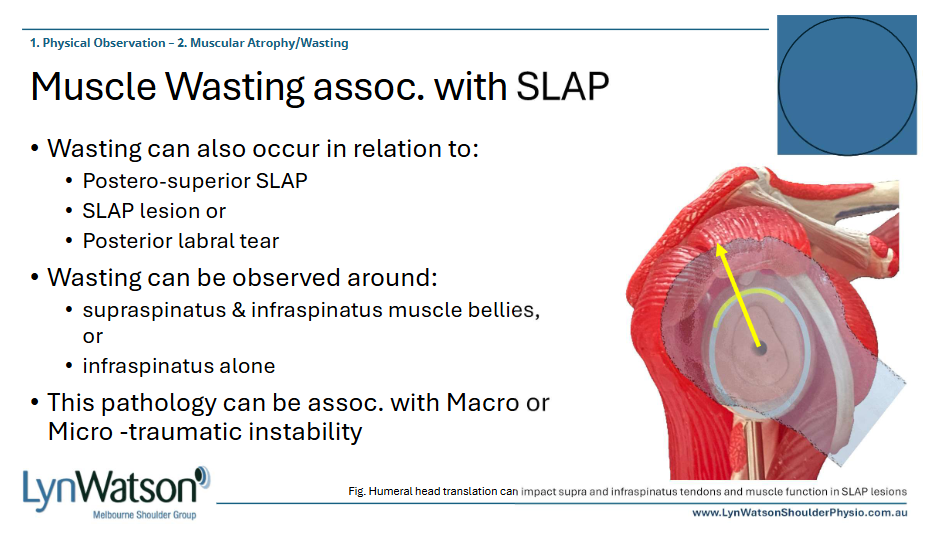
Muscular Athropy/Wasting
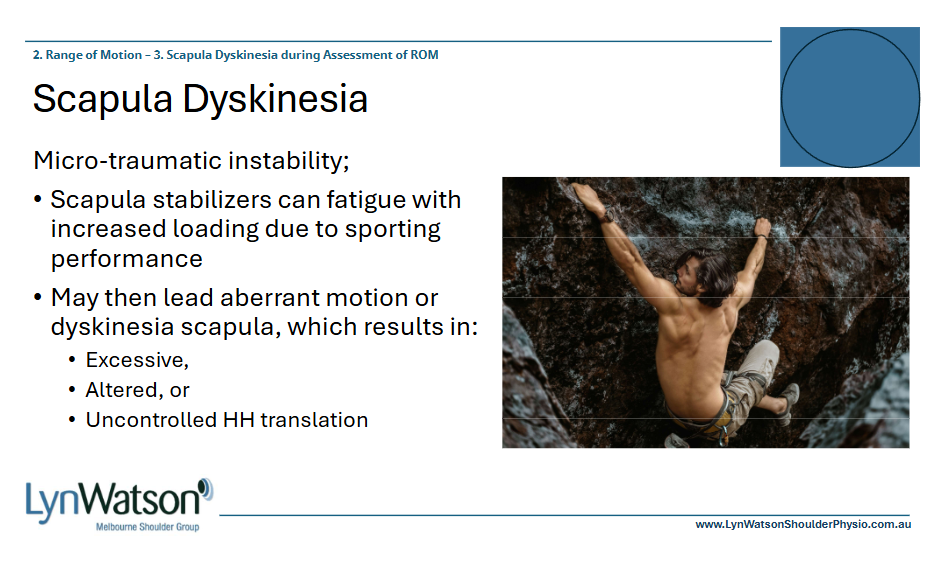
Scapula Dyskinesia
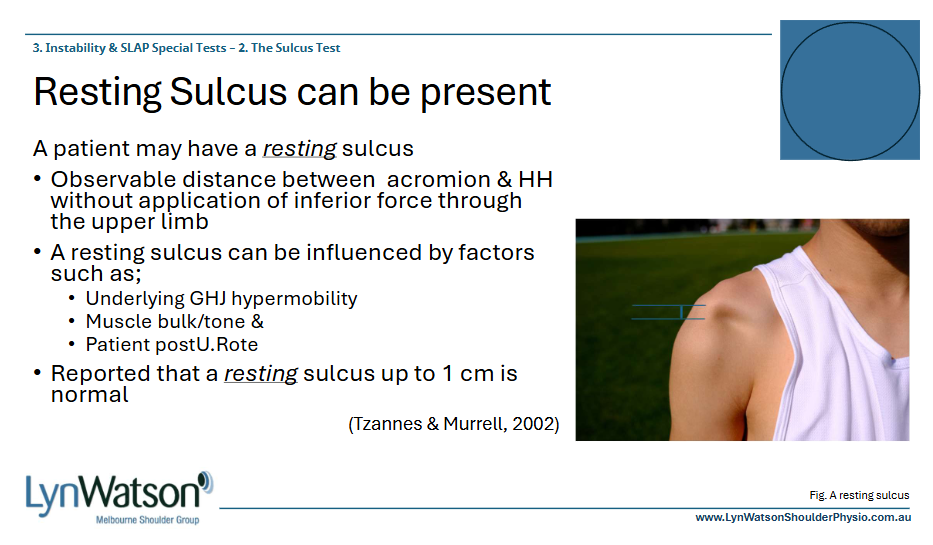
The Sulcus Test
Curriculum
-
-
(Included in full purchase)
Introduction
-
(Included in full purchase)
-
-
(Included in full purchase)
1.1 Humeral Head Position at Rest
-
(Included in full purchase)
1.2 Muscular Atrophy / Wasting
-
(Included in full purchase)
1.3 Scapula Resting Position +/- Muscle Wasting
-
(Included in full purchase)
1.4 Muscular Hypertrophy/Bulk
-
(Included in full purchase)
-
-
(Included in full purchase)
2.1 General Comments
-
(Included in full purchase)
2.2 Humeral Head Translation / Subluxation during Assessment of ROM
-
(Included in full purchase)
2.3. Scapula Dyskinesia during Assessment of ROM
-
(Included in full purchase)
2.4 Glenohumeral Joint Internal Rotation Deficit (GIRD)
-
(Included in full purchase)
-
-
(Included in full purchase)
3.1 Instability & SLAP Special Tests General Information
-
(Included in full purchase)
3.2 The Sulcus Test
-
(Included in full purchase)
3.3 Anterior & Posterior Draw Tests
-
(Included in full purchase)
-
-
(Included in full purchase)
1. Rotator Cuff & Muscle Assessment
-
(Included in full purchase)
4.2 Upward Rotation Test (Shoulder Shrug Test)
-
(Included in full purchase)
4.3 External Rotation Loading Test
-
(Included in full purchase)
4.4 Internal Rotation Testing
-
(Included in full purchase)
4.5 Extension Strength Assessment
-
(Included in full purchase)
4.6 Flexion Strength Assessment
-
(Included in full purchase)
-
-
(Included in full purchase)
5.1. Scapula & Humeral Head Correction - Introduction
-
(Included in full purchase)
5.2 The Uses of Scapula & Humeral Head Correction
-
(Included in full purchase)
5.3 The Scapula
-
(Included in full purchase)
5.3 The Scapula Extra Resources
-
(Included in full purchase)
5.4 Humeral Head Correction
-
(Included in full purchase)
5.5 Correction with Loaded Tests
-
(Included in full purchase)
5.5 Correction with Loaded Tests Extra Resources
-
(Included in full purchase)
-
-
(Included in full purchase)
6.1 X-ray
-
(Included in full purchase)
6.2 MRI / MRA
-
(Included in full purchase)
6.3 Computer Tomography Scans
-
(Included in full purchase)
6.4 Imaging Specific to Instability Sub-Groups
-
(Included in full purchase)
-
-
(Included in full purchase)
7. Isolated Subscapularis Tendon Pathology
-
(Included in full purchase)
What people are saying
Trusted by physiotherapy professionals worldwide to deliver real clinical results.
Thanks so much! You wouldn’t believe the patient that walked in today. A failed bicep tenodesis followed up with a MUA and EUA/washout for suspected infection, with a unrepaired partial Subscap tear left (and still causing pain)...and ... you guessed it a shoulder sitting so low she get nTOS signs into the ulnar distribution of the hand if she relaxes it by her side. At lease I know where to start now!
Physio
I attended the shoulder level 2 course on the weekend. I thought it was a fantastic course and really appreciated the in depth analysis and evidenced based approach to treatment that both Lyn and Simon presented. It makes you reflect on your own case load, past and present, and realise some of the areas I can really improve on.
Physio
Thank you so much for delivering the course over the weekend. Found it fantastic and especially after having two rotator cuff repairs myself, I now realise where I can improve my own and patients' rehabilitation.
Physio
Thanks for a great course last weekend, I learnt a lot and will be back for the level 2 course.
Ready to Elevate Your Practice?
Join now to access expert guidance, practical training, and a supportive community of physiotherapy professionals. Take the next step towards mastering physiotherapy and achieving your career goals!